
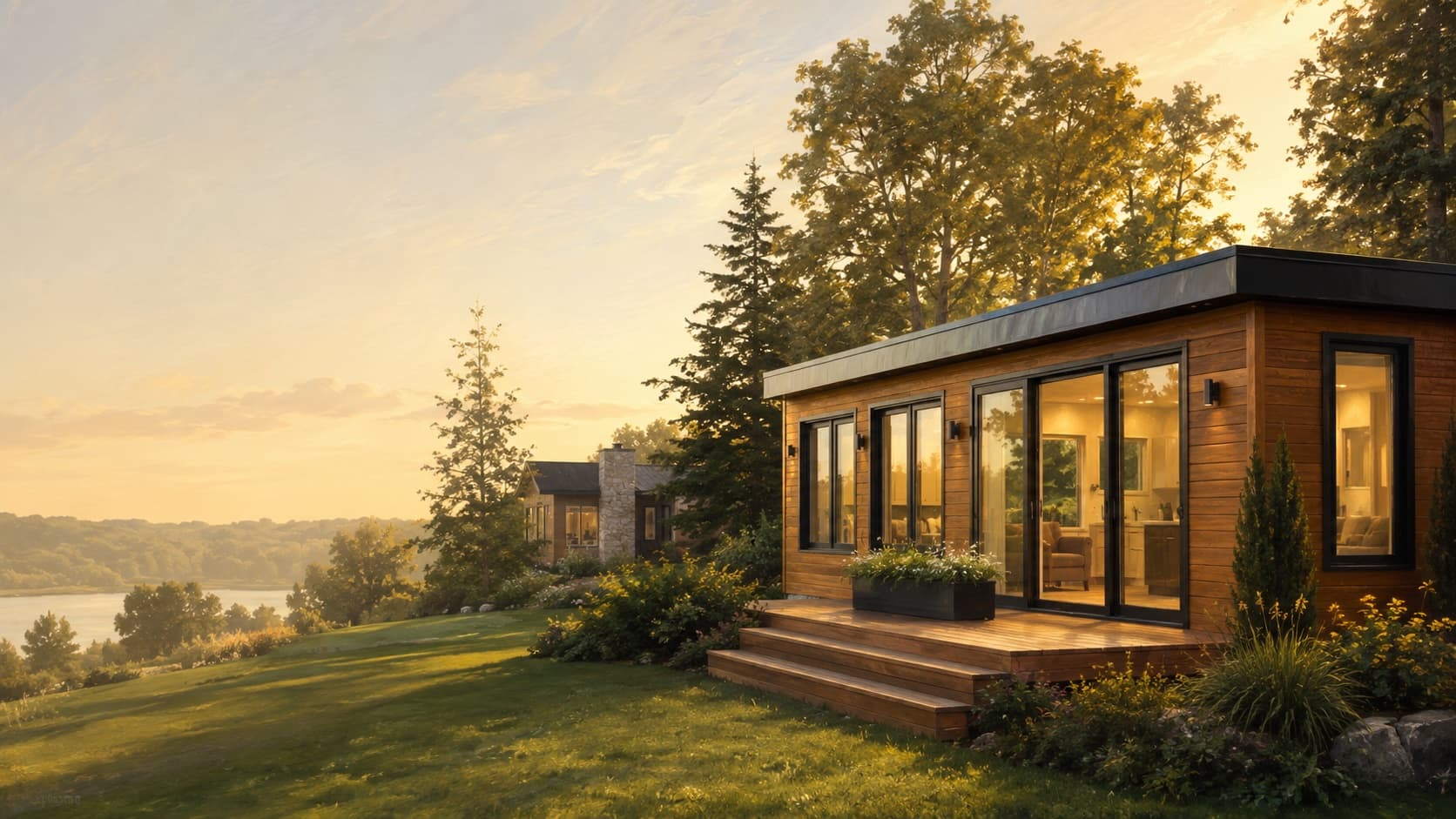
The calculator answers one question: at the rent you enter, what does this suite put in your pocket every month? Everything on the result screen either builds that number or tells you how much slack you have. Here's how to read it.
Monthly cash flow
Rent collected, less a vacancy allowance, less the ongoing costs (property tax, insurance, a maintenance reserve), less the interest on whatever you borrowed. What's left is what lands in your account. For a backyard suite on land you already own, at Ontario market rents, this is usually comfortably positive from the first tenant.
Break-even rent
The rent at which the suite exactly carries itself — costs covered, nothing left over. It's the number to check your local market against. If comparable units in your area rent well above break-even, you have margin for a soft rental market, a rate increase, or a bad year. If they rent close to it, you're relying on everything going right.
Why interest only, and where principal went
Cash flow here is shown on an interest-only basis. Principal repayment isn't an expense — it's a transfer from your cash into your equity, and counting it as a cost makes a perfectly sound rental look like it loses money. It's also the realistic short-run picture: most ADU builds are carried on a HELOC or a bridge facility and rolled into the primary mortgage at renewal. Switch the result to principal-plus-interest and you'll see the blended payment, with the principal portion called out separately — because that part you keep.
What the number leaves out
Income tax on the rental income (deductions for interest and operating costs partly offset it, but the net depends on your bracket — ask your accountant). Property management, which almost nobody hires for a single backyard suite. Utilities, on the assumption the tenant pays their own. And HST: it's payable on the build and recoverable through the enhanced rental rebate, so we show it as its own line rather than carrying it in the monthly figure — but you do have to front it at closing.
Which mode should you pick?
The calculator's three modes apply different cost structures, tax rules, and vacancy assumptions. Picking the wrong mode produces wildly wrong numbers.
ADU mode — when you already own land
You own the property. You're adding a garden suite, laneway suite, or other Additional Residential Unit (ARU) to bring in rental income. This mode applies the Ontario Bill 23 development-charge waiver automatically, sets land cost to zero, and uses single-unit vacancy assumptions. This is the scenario with the strongest returns — no land capital, no development charges on a qualifying suite, and deductible interest on HELOC or mortgage-extension financing.
Single rental mode — buying a unit + land
You're buying both land and a modular home, setting it up as a standalone rental property. This mode includes land cost, uses standalone investor financing (typically 20–25% down), and applies full property tax assessment rather than incremental. Bill 23 does not apply because the unit isn't additional to an existing residential property. The math works in less-expensive Ontario markets (Belleville, Sudbury, Sault Ste. Marie) and gets tight in the GTA.
Multi-unit / cottage mode — multiple cabins on acreage
You own (or buy) cottage country land and place two or more modular cabins for seasonal or short-term rentals. This mode spreads land cost across multiple units, defaults to a 25% vacancy rate to reflect seasonal demand patterns, and scales rent and operating costs per unit. Best fit: Muskoka, Haliburton, Bruce County locations with consistent short-term rental draw. Worst fit: speculative builds in markets without proven booking demand.
For a deeper walkthrough of when each scenario works (and when it doesn't), see Should You Buy a Modular Home as a Rental in Ontario?.
Why modular for rentals specifically
The investment thesis isn't “modular vs traditional” on rental yield — long-run yields are comparable once the asset is built. The thesis is about speed, predictability, and rental suitability:
- 4–6 months from contract to occupancy versus 12–24 months for site-built. Rent starts flowing a year sooner. On a 5-year hold, that's a full extra year of cash flow plus a full extra year of asset appreciation.
- Predictable pricing. Factory production removes the cost-overrun risk that plagues site-built rentals. The number you finance is close to the number you spend.
- CSA Z240MH and A277 certifications are accepted by every major Canadian lender, including standard investor mortgage products. No exotic financing required.
- Efficient footprints. Most modular floor plans are 600–1,400 sq ft — exactly the size that maximizes rent-per-square-foot in tight long-term rental markets.
Canadian rules that move the number in your favour
The calculator deliberately stays out of your tax return — but a few rules are worth knowing, because they improve the real-world result beyond what the monthly figure shows:
- Bill 23 (Ontario) waives municipal development charges, parkland dedication fees, and community benefit charges on most additional residential units. This one is in the math — applied automatically in ADU mode. Savings: typically $20K–$50K depending on the municipality, which is $20K–$50K less to finance.
- Mortgage interest is fully deductible against rental income in Canada — including HELOC interest, mortgage-extension interest, and standalone investor mortgage interest, provided the borrowed funds can be traced to the rental purchase. The calculator charges you the full interest without crediting the deduction, so your after-tax position is better than what you see.
- Vacancy and operating costs are deductible too — property tax, insurance, repairs. Same story: they're charged in full here, and the deduction is upside your accountant claims.
- CCA (Capital Cost Allowance) on the building is optional and consequential. Claim it and you reduce current taxable income, but trigger recapture on eventual sale and it can affect your principal residence exemption. Most accountants suggest skipping it on a residential rental unless there's a specific reason. It plays no part in these numbers.
For a deeper look at financing structures and which lender path fits your scenario, see our guide on Modular Home Financing Options in Ontario. If your scenario is an ADU on existing land, the Ontario ARU Grants Directory lists municipal grant and forgivable-loan programs you can stack against the Bill 23 waiver.
Five mistakes to watch for
- Reading cash flow as the whole return. It isn't. A rented suite also pays down principal if you're amortizing, and it adds a second dwelling to a property you already own. Cash flow is the part that shows up in your bank account — the rest shows up when you refinance or sell.
- Using market rent without a vacancy buffer. Default vacancy in the calculator is 5% for long-term rentals and 25% for short-term cottage scenarios. If your market is softer than that, override the default. CMHC rents are starting estimates, not guarantees.
- Ignoring property tax assessment changes. A standalone rental purchase triggers a full assessment. An ADU triggers an incremental assessment on the new structure only. The calculator handles this per mode; if you're in an unusual jurisdiction, check with the local municipality for the actual assessed value.
- Co-mingling HELOC funds. Canadian tax rules require you to trace borrowed funds to the rental purchase for interest to be deductible. Don't draw HELOC funds into a chequing account that also pays personal expenses — that complicates CRA conversations and can disqualify the interest deduction.
- Not running a stress scenario. Rates can move. After you've run your base case, run it again with the interest rate up 1.5 percentage points. If the deal still works at the higher rate, you have a real margin of safety. If it doesn't, you're buying rate exposure as much as a property.
Next step: get a second set of eyes
The calculator gives you the math. The next step is pressure-testing the assumptions against the specific property, the specific municipality, and the specific financing on offer. Click Send + Get a Callback on the calculator results page and James Clarke (REALTOR®, General Manager) will reach out within a business day to walk through your scenario, flag anything that looks off, and connect you to the right General Coach floor plan if you want to move forward.